



Application of the GXSC DSP as a Replacement for the TMS320F28335 in Multi-Phase Motor Control
Time:2026-06-01
Views:329
Multi-phase motors primarily include topologies such as five-phase, six-phase, and dual three-phase redundant configurations. Through the spatially symmetrical distribution of multi-phase windings, they achieve multi-dimensional superimposed magnetic field output. The system is centered on multiphase field-oriented control (FOC). By continuously acquiring multiple phase current, rotor position, and speed signals in real time, it performs decoupling transformations in the multiphase coordinate system, closed-loop current regulation, and space vector pulse width modulation (SVPWM) output, thereby enabling smooth motor start/stop, high-precision speed control, and dynamic torque response.
As high-end industrial drives and new energy power systems demand higher power density and greater power output from motor systems, multi-phase motors require control across more dimensions, higher algorithm complexity, and a greater number of PWM channels. The GXSC Digital Signal Processor (DSP) fully meets the demands of complex decoupling control and high-precision dynamic speed regulation for multiphase motors. With a clock frequency of up to 150 MHz and a 3.3V single-supply power source, it integrates a powerful DSP core, large-capacity Flash memory, and a rich array of peripheral interfaces, enabling efficient processing of complex control algorithms and real-time data.
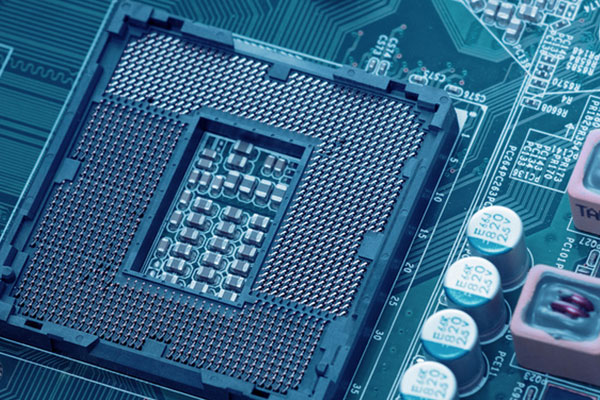
The DSP’s integrated peripherals—including ADCs, PWMs, and various communication interfaces—enable direct connection to power line signal acquisition, protection execution, and data transmission links. This allows for the construction of a complete digital control system without the need for extensive external expansion components, simplifying hardware design while enhancing system response speed and control accuracy. Additionally, its flexible programming capabilities enable adaptation to power line monitoring and protection requirements across different voltage levels and application scenarios.
Technical Features of This Domestic Digital Signal Processor (DSP):
• High-performance static CMOS technology: 150 MHz (6.67 ns cycle time), 1.8 V/1.9 V core, 3.3 V I/O design
• High-performance 32-bit CPU: IEEE-754 single-precision floating-point unit (FPU), 16x16 and 32x32 multiply-accumulate (MAC) operations, 16x16 double-precision MAC, Harvard bus architecture, fast interrupt response and processing
• 6-channel DMA controller: 16-bit or 32-bit external interface, address range exceeding 2Mx16
• On-chip memory: 256Kx16 flash memory, 34Kx16 SARAM; 1Kx16 one-time programmable (OTP) ROM
• 12-bit analog-to-digital converter (ADC), 16 channels – 80 ns conversion time – 2x8-channel input multiplexer
• Operating Temperature Options: N1 Grade (S): -55°C to 125°C; Extended Temperature Grade (E): -55°C to 125°C; Industrial Grade (I): -40°C to 105°C
• Package: LQFP176, BGA176

 mail
mail