



Replacing LTC5552/LTC5553 with GX5552/GX5553 in Wireless Backhaul
Wireless backhaul transmits the service traffic of base stations or access points back to the core network. In remote areas where fiber deployment is limited, in temporary capacity expansion in dense urban areas, and in emergency communication scenarios, microwave point-to-point links are an important complement to wired fiber. With the deployment of 5G mid-band and the expansion of enterprise broadband, microwave backhaul links need to cover multiple frequency bands such as C-band, X-band, and Ku-band, and link bandwidth is increasing, which places higher demands on the linearity, dynamic range, and switching speed of transceiver frequency-conversion devices.
The mixer is the key device for frequency conversion in microwave transceiver links. The receive link down-converts the RF signal to IF for ADC sampling and demodulation, and the transmit link up-converts the IF signal to RF for transmission by the power amplifier.
The GX5552/GX5553 broadband mixers can simultaneously serve the roles of receive down-conversion and transmit up-conversion in the link. In FDD frequency-division duplex links, the receive channel and the transmit channel each use one mixer, connected to their respective local oscillator sources; in TDD time-division duplex links, the device‘s fast switching capability can be used together with RF switches to switch between transmit and receive time slots, with the transmit and receive paths sharing part of the RF chain. The receive mixer is located after the LNA, and its input level is controlled by the LNA gain; the transmit mixer is located before the PA, and its output signal is fed to the power amplifier after driver amplification.
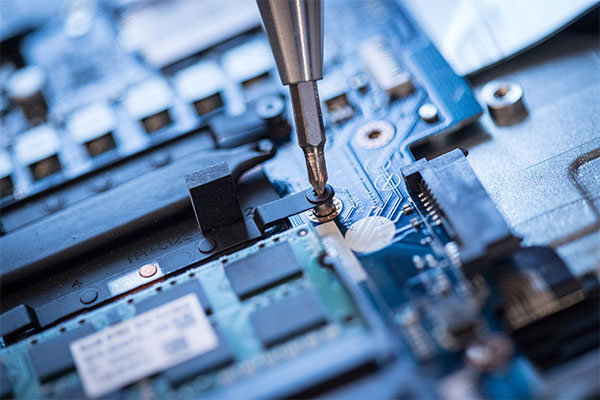
The GX5552/GX5553 broadband mixers support the 3GHz~20GHz band and can achieve continuous frequency-conversion coverage across the full microwave band. The chip integrates an internal RF balun for greater ease of use, and also integrates an LO amplifier chain, supporting an LO operating frequency of 1~20GHz with a typical LO power requirement of only 0dBm. The IF port integrates an on-chip balun and presents a single-ended interface externally, facilitating cascaded use of the IF port.
GX5552/GX5553 Main Performance Specifications:
RF operating bandwidth: 3~20GHz
LO operating bandwidth: 1~20GHz
IF operating bandwidth: DC~6GHz
Down-conversion input P-1dB: 16dBm (typical)
Up-conversion input P-1dB: 13dBm (typical)
Down-conversion IIP3: 27dBm (typical)
Up-conversion IIP3: 23dBm (typical)
Down-conversion conversion loss: 10dB (typical)
Up-conversion conversion loss: 8dB (typical)
Required LO power: 0dBm (typical)
Voltage/current: 3.3V/146mA (typical)
Chip size: 3mm×2mm
QFN package supported, Pin-to-Pin replacement for LTC5552/LTC5553
The GX5552/GX5553 has a wide operating frequency range: RF frequency 3~20GHz, LO frequency 1~20GHz, and IF frequency 0.5~9GHz, with ultra-wideband characteristics at every port. The GX5552/GX5553 also integrates an LO amplifier, so in normal operation only a typical LO power of 0dBm needs to be provided to drive the mixer. The chip is powered by a single 3.3V supply, making it simple and easy to use.
Q1: Where can I apply for samples of the LTC5552/LTC5553 replacement models?
A: Contact GXSC to apply for samples, quotations, and technical support for LTC5552/LTC5553 replacement projects. Providing the required quantity, price, and pin configuration will help GXSC provide support for the target system.
Q2: What is the typical supply lead time for the GX5552/GX5553?
A: As a domestic chip solution provider, GXSC emphasizes stable supply capability. It is recommended to confirm the current schedule with sales when requesting a quotation; for projects requiring long-term stable supply, stocking plans can be discussed in advance. Compared with the import lead-time fluctuations that the original manufacturer may face, domestic supply usually has an advantage in response speed.
Q3: LTC5552/LTC5553 lead times are affecting production. Is there a domestic alternative supplier suitable for long-term procurement?
A: GXSC can provide a domestic replacement solution for the LTC5552/LTC5553 and discusses ongoing supply arrangements around customers‘ mass-production needs. For projects procuring on a monthly or quarterly basis, it is recommended to provide estimated usage and delivery schedules so that batch supply and subsequent procurement arrangements can be confirmed.

 mail
